Posts

Showing posts with the label Not Rocket Science

Understanding Compound and Annualised Growth

Image
Across fund manager houses, there is little standardisation of how performance figures are presented on fact sheets. Percentage returns are usually presented as either (i) discrete (or calendar) annual, (ii) cumulative (for example a total return figure for 3 years or 5 years) or (iii) annualised (the equivalent annualised return for a period such as 3 or 5 years, sometimes called compound annual return). This tutorial shows you how to convert from discrete annual performance figures, to cumulative or annualised figures, over a period of your choice. As an example, we’ll look at some USD fund performance data presented in an October 2010 factsheet. The performance data are presented to us in a very clear way, but may not be the complete picture we are looking for. The table directly above shows the discrete annual returns - ie. net of fees the fund delivered 7.46% in 2009, -4.90% in 2008, 9.82% in 2007, etc. But let’s suppose you ask yourself (or your advisor) “What was the total growt...
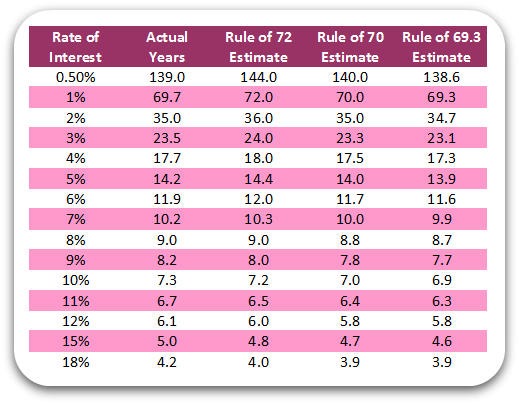
Future Value Calculation and the Rule of 72

Image
Getting down and dirty with the CAGR formula The Basics Let’s say you have an asset worth $100 now, and you want to find out what it’s value will be in 5 years if it grows at a rate of 10% per annum and interest is compounded. The equation is simple. The asset’s future value (FV) and present value (PV) are related as follows: $$FV = PV\times(1+i)^n$$ where i is the rate of interest and n is the number of periods. In our example: $$FV = $100\times(1+0.10)^5 = $161.051$$ Here the total growth over the 5 years FV/PV is 161.051/100 = 1.61051 . This gives us the total cumulative return r. $${FV \over PV} = (1+i)^n = 1+r$$ Or expressed in percentage terms: $$r = [(1+i)^n - 1] \times 100$$ ( equation A ). In our example, (1.61051-1) x 100 = 61.051%. If we rewrite the future value calculation to solve for i: $$i = \left[FV \over PV\right] ^{1/n} - 1$$ ( equation B ), then substituting in for r and in percentage terms: $$i = [ (1+r)^{1/n} - 1 ] \times...

Asset Allocation for the Ordinary Investor

Image
In less than 15 minutes find out about a simple but proven method for constructing your portfolio from the top down