Posts

Showing posts with the label Economics

Investment Outlook For 2018

Image
After a nervous start to 2017 for investors, growth continued and the year ended on a higher note than most expected.  As we enter 2018, it’s a good time to survey the global economy and decide if our asset allocation is still appropriate. In this article I aim to address these straightforward questions: Will there be a recession in 2018? How cautious should I be in my investment approach? Where are the investment opportunities for the year ahead? What asset classes should I overweight or underweight in my portfolio? I will also reveal why an ox weight-guessing competition, held in 1906 at the West of England Fat Stock and Poultry Exhibition, helps us derive more useful information than individual leading economists do about the risk of imminent recession. This is good stuff, you really should read on! Please share this article! >> Review of Key Economic Reports Remembering the First Law of Economists , it’s a good idea to conduct a broad survey of what ...

The Law Of Economists

Image
The First Law of Economists: For every economist there is an equal and opposite economist. The Second Law of Economists: They’re both wrong. Side note: When an economist says the evidence is “mixed,” he or she means that theory says one thing and data says the opposite.

Key Interest Rate Definitions

Image
Definitions of the various types of interest rate Central bank rate - is the one most generally referred to in the financial press when they talk about the ‘bank rate’ or ‘interest rate’ without further specification (except for the USA, see below). Set by policymakers and usually the key rate upon which others are based. Also called the ‘base rate’ in the UK, ‘cash rate’ in Australia and New Zealand, and ‘discount rate’ in the USA. It’s the rate at which the central bank lends money overnight to commercial banks. Federal funds rate - specifically in the USA, policymakers at the Federal Reserve use a slightly different mechanism for influencing the nation’s interest rates. The federal funds rate is the overnight rate at which banks lend reserve balances to each other. The Federal Reserve Open Market Committee (FOMC) sets a target for this rate and implements monetary policy through ‘open market operations’ - buying or selling government securities (Treasury bills and bonds) in the op...

Why Have Bond Prices Suddenly Fallen?

Image
The last few days have a seen a rout in the bond market… Why? What does it mean? Very briefly, the market sees Donald Trump’s policies thus: Fiscal stimulus from lower taxes and increased government spending on infrastructure etc., will massively increase the need for US government borrowing. Couple this with increased protectionism on imports, and you have significant inflationary pressures. On top of this, there is a still a fair chance of the Federal Reserve raising interest rates in December. In times of rising inflation and interest rates, bond yields rise. The expectation is that new government borrowing (selling bonds) will need to be at more attractive yields than currently on offer. This forces the market price of currently issued bonds downwards, because the price of an existing bond must reflect the option of the bondholder to sell and trade in for new bonds that have a higher yield. Hence we see bond prices plummet as the market ‘prices in’ the prospect of higher governm...

Blowing the Lid off the Biggest Scam in Big Business

Image
Let’s get back to basics. When you buy a company’s stock, you are literally buying a ‘share’ of that business. You own a piece of the company, and so have a right to a share of the profits. For simplicity, the profitability of a company is usually given as ‘earnings per share’ (EPS), which is the net income of the firm divided by the number of shares outstanding. It’s usual for some of a company’s earnings to be distributed back to shareholders as dividends, and some earnings to be retained and invested into growth of the business. The ability of a company to grow and increase earnings into the future underpins the value of the firm. The expectation of investors for earnings growth is reflected in the ‘price-earnings ratio’ (P/E), also called the ‘earnings multiple’. The P/E is the share price divided by the earnings per share. A company in a traditional low-growth industry will usually have a lower P/E than those in a more glamorous high-growth sector. For example, as of January 2016...

Current Global Interest Rates, and the Long Term Global Trend

Image
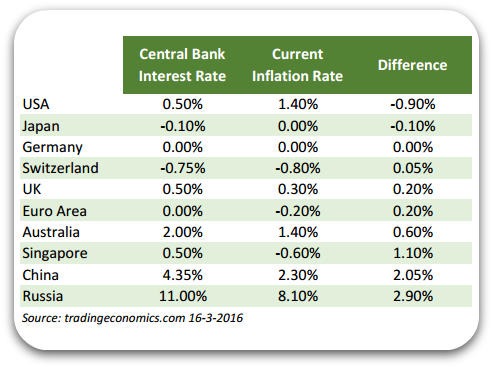
(Reminder: Key interest rate definitions ) Since we’re all waiting to hear what the Federal Reserve will do with interest rates later today, I thought it would be helpful to take a quick glance at some other major economies. The most likely long term trend for global interest rates is persistently low Long term interest rates have been falling for thirty years, and a bunch of people way smarter than me think this is more likely to continue than otherwise. Here are two fascinating reports: Secular Drivers of the Global Real Interest Rate December 2015, a staff working paper from the Bank of England. Long-Term Interest Rates: A Survey July 2015, from the Executive Office of the President of the United States, no less. In case you don’t want to spend a weekend reading them, here are some juicy bits… First, from the Bank of England research: “ Long-term real interest rates across the world have fallen by about 450 basis points over the past 30 years. The co-movement in rates across both a...