Posts

Showing posts with the label Basics

Who Cares What Happens in the Markets Today?

Image
Think for a moment, if you will, about the job of a financial journalist. Typically, a salaried journalist needs to write something every day, otherwise he doesn’t get paid. Many financial journalists are in this situation; and the subject they have to write about is what the markets are doing right now. That means, even if there is nothing substantially newsworthy in the markets, they still have to create headlines. That’s why you’ll often see headlines like: Prices dip on profit taking from Friday’s gains. Does this actually tell us anything useful at all? Prices were up before and now they are down. This is the financial-world equivalent of reporting that forgetful Mr Jones misplaced his car in the multi-storey, or that Elvis is still dead. If you’re a day-trader, or a very short-term investor, then probably yesterday’s stockmarket movements will be important to you. But if you are a long term saver and investor, then almost certainly the market’s fluctuations from one day to the...

How Much To Save - A Rough Guide

Image
If you haven’t yet started to save for your retirement, the following can be used as a basic guideline. Based on some typical assumptions, including: You plan for 80% replacement of pre-retirement pre-tax income, adjusted for inflation and with a high likelihood of being sustained for up to 30 years (retirement at age 65) State pension or other income will provide 25% of your retirement income needs each year Starting early is important, because once you start, the same savings goal applies until you retire. For example, if you start saving roughly 12% of your income in your mid-20s and have the discipline to maintain your savings plan, you shouldn’t have to increase that percentage as you go through your 30s, 40s and so on. The above table is of course just a general guideline. Your financial advisor will work with you to create your personalised savings plan aimed at meeting your individual financial objectives.

Dollar Cost Averaging

Image
How Regular Savings Create Gains From A Falling Market Dollar Cost Averaging is a strategy in which an investor places a fixed dollar amount (or indeed any other currency) into a given investment such as a unit trust, on a regular basis. The investment generally takes place each and every month regardless of what is occurring in the financial markets. As a result, when the price of a given investment rises, the investor will be able to purchase fewer units. When the price declines, the investor will be able to purchase more units. Millions of investors around the world employ a dollar cost averaging strategy because it offers the following benefits: It’s an attractive option for investors who want to contribute to their investment portfolios on a regular basis. It eliminates the issue of ‘market timing.’ As a result, an investor’s returns will be determined more by the overall trend in a given fund as opposed to the investor’s specific entry price. In addition, it helps investors reduc...

What Happens when your Financial Advisor changes Firm?

Image
The same as in any industry, your financial advisor may sometimes ‘move on’, and it could be for a variety of reasons: a stimulus from inside the firm; an opportunity for professional development; retirement or semi-retirement; or perhaps just time for a change. In the international arena, financial advisers might change firm but stay in town, or change location with the same firm, or change both firm and location. Why Has My Advisor Suddenly Disappeared? Good financial advisors build long term working relationships with their clients. It’s natural to be concerned or worried when a sudden change or break in communication happens. Lack of information creates uncertainty, which nobody likes. However, there can be several underlying factors behind a temporary lack of clarity: The departing advisor might be under a confidentiality agreement, to not disclose details of any job offer made to him or her. The advisory firm that is losing the advisor might be disorganised or ineffective in ...

How to Build $1 Million by Age 55

Image
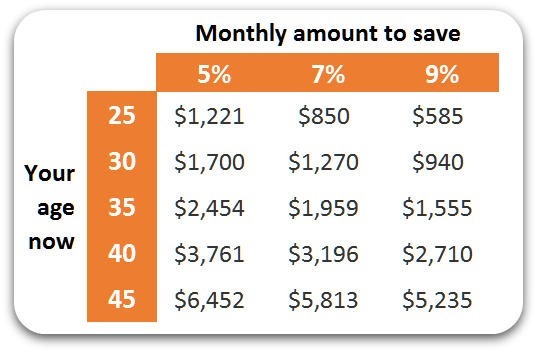
Suppose you wanted to build a retirement fund of $1 million by the time you’re 55. If you were starting from scratch, how much must you save each month? It goes without saying that the two important factors are the rate of return on your money, and the time it has to grow . (Note that the annual growth rates used in the above table are net - i.e. they are after any investment charges or costs of any savings product.) To see more detail about how your savings might grow, take a look at the following: Retirement contribution calculator table (6%) Retirement contribution calculator table (7%) Retirement contribution calculator table (8%)